
c. 1570
Mission of St. Andre
The Jesuits began mission work among the St. Thomas Christians in the region that formed the historic Mission of St. Andre of Muterte.

The story of the Diocese of Alleppey grows from the historic Jesuit Mission of St. Andre, centuries of coastal Christian life, pastoral change and the eventual erection of the diocese in 1952.
The diocesan history traces this local Church to the Jesuit Mission of St. Andre and the network of churches that grew through the coastal Christian community.

Jesuit missionary • St. Andrew's, Arthunkal
The official history records Fenicio’s service at St. Andrew’s, Arthunkal, in the periods 1584–1602 and 1619–1632, and remembers him as a pioneer in Indology.
The Diocese of Alleppey was erected by Pope Pius XII through the Papal Bull “Ea Redemptoris Verba” dated 19 June 1952.
Date of erection of the Diocese of Alleppey.
Executorial Decree assigning supplementary personal jurisdiction between Alleppey and Cochin.
The decree became effective.
After the Coonan Cross Schism, the mission community was reconciled to Rome through Msgr. Guiseppe Sebastiani.
The mission remained under the Vicariate of Verapoly through the Carmelite period until the restoration of the old Cochin Diocese.
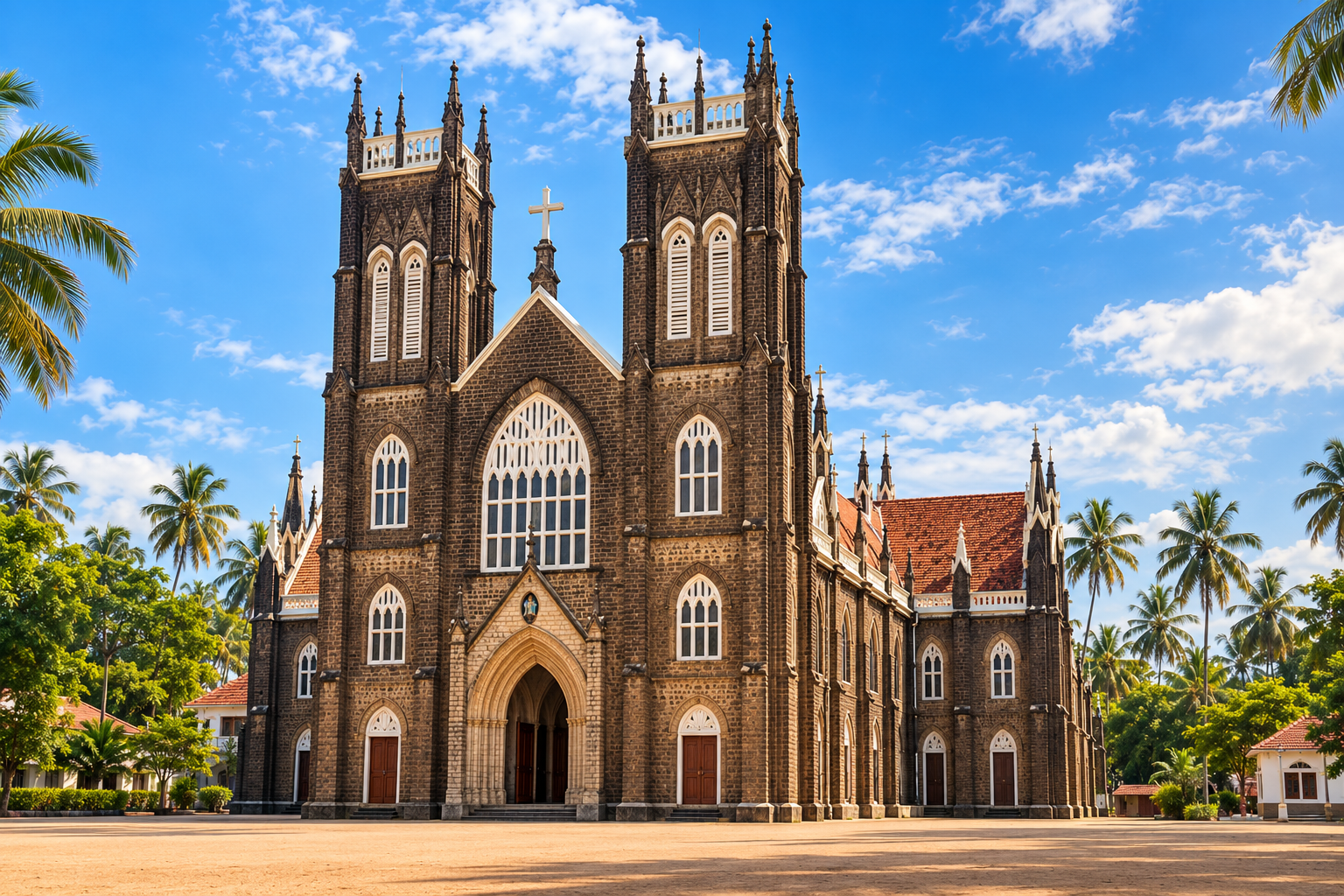
The official history links the elevation of St. Andrew’s Church at Arthunkal to its historical importance, tradition and the faith of its people.
The Diocese of Alleppey was formed from the northern territory of the old Cochin Diocese. The official history places the dividing line at the Kuthiathodu Canal Line, with the territory north of the line belonging to Cochin and the territory south of it belonging to Alleppey.
The executorial decree of 8 September 1952 also gave each diocese a supplementary personal jurisdiction over certain parishes situated within the territory of the other. This decree was approved on 24 September 1952 and became effective on 11 October 1952.
Kuthiathodu Canal Line.
A straight line from the curve of the Pampa River at Viyapuram to the Arabian Sea through Thottappally.
The middle of Vembanadu Lake, continued south by the Pallathuruthy Canal to Viyapuram.
The Arabian Sea.
The official account describes the territory of the Diocese as roughly corresponding to the historic Jesuit Mission of St. Andre of Muterte.
The official narrative describes an intense century of Jesuit mission work that significantly increased the Christian community from Cochin to Purakad and provided it with several churches.
One of the principal churches associated with the Jesuit mission in the region.
Another important church identified in the historical account.
A coastal church belonging to the network developed during the mission period.
One of the later churches named in the official list of the mission period.
The source also records that some churches built during this period were subsequently destroyed through wars or sea erosion, reflecting the changing history of the coastal region.
After the Coonan Cross Schism, the Christians of the Mission of St. Andre were reconciled to Rome through Msgr. Guiseppe Sebastiani during his second tour of Malabar in 1662. The official history presents this reconciliation as an important moment in the continued ecclesial life of the community.
Even after the Dutch capture of Cochin, the Jesuits continued to look after the Christians of the area until approximately the middle of the eighteenth century. The mission was subsequently taken over by Carmelite missionaries and remained under the Vicariate of Verapoly until the restoration of the old Cochin Diocese in 1886.
Key milestones from the official diocesan history.
The Jesuits began mission work among the St. Thomas Christians in the region that formed the historic Mission of St. Andre of Muterte.
St. Andrew’s Arthunkal is recorded as one of the important churches established during the Jesuit period, alongside later coastal churches in Kattoor, Thumpoly and Manakodam.
The Italian Jesuit served as Vicar of St. Andrew’s Church, Arthunkal, first from 1584 to 1602 and again from 1619 until his death in 1632. The diocesan history remembers him as a pioneer in Indology.
Following the Coonan Cross Schism, the St. Thomas Christians of the Mission of St. Andre were reconciled to Rome during Msgr. Guiseppe Sebastiani’s second tour of Malabar.
Even after the Dutch capture of Cochin, the Jesuits continued to care for the Christians of the area until about the middle of the eighteenth century.
The mission was then entrusted to Carmelite missionaries and remained under the Vicariate of Verapoly until the restoration of the old Cochin Diocese in 1886.
Pope Pius XII erected the Diocese of Alleppey through the Papal Bull “Ea Redemptoris Verba”, dividing the northern territory of the old Cochin Diocese at the Kuthiathodu Canal Line.
A decree assigned supplementary personal jurisdiction to the dioceses of Alleppey and Cochin over certain parishes located within the territory of the other.
The executorial decree received approval from the Sacred Congregation for the Propagation of Faith.
The new ecclesiastical arrangement and supplementary jurisdiction became effective.
Because of Arthunkal’s historical importance, tradition and the faith of its people, Pope Benedict XVI declared St. Andrew’s Church a Basilica.
The elevation to Basilica was solemnly proclaimed during the Pontifical Mass celebrated by Most Rev. Salvatore Pennacchio, Apostolic Nuncio to India.
Rt. Rev. Dr. James Raphael Anaparambil assumed charge over the governance of the Diocese of Alleppey as its fourth Bishop.
The official site presents four bishops in the diocesan succession.
19/392, Bishop's House, P.B. No. 4804, Alappuzha, Kerala, India – 688012